
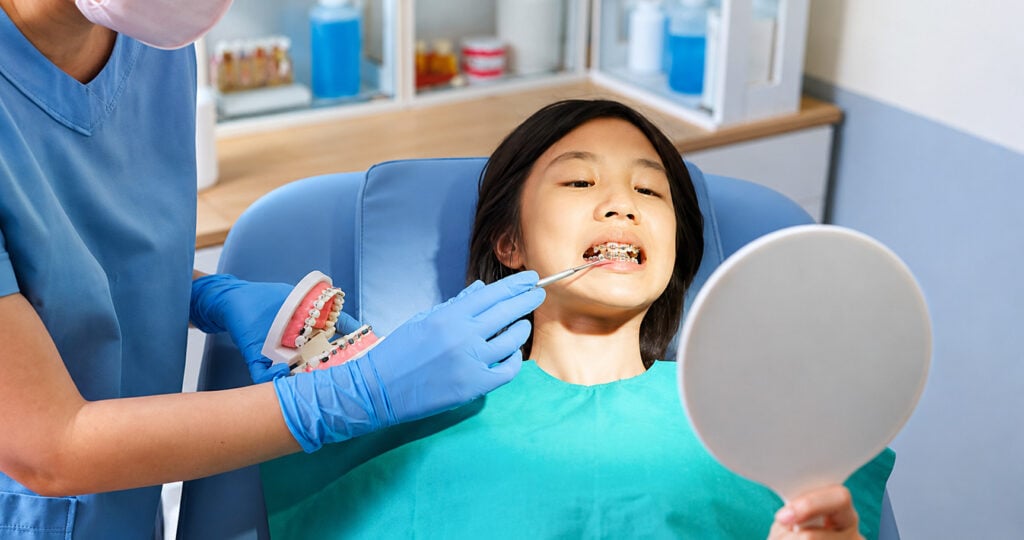
Braces for bite problems do much more than create straighter teeth. Orthodontic treatment can improve how the upper and lower teeth meet, helping protect dental health and support more comfortable oral function.
At Endeta Dental Clinic, every orthodontic plan begins with an assessment of the teeth, jaws and bite. The goal is to correct the underlying problem rather than focus only on visible tooth alignment.
What Is A Healthy Bite?
Your bite describes how the upper and lower teeth come together when you close your mouth. Dentists also use the term “occlusion.”
In a balanced bite, the teeth meet in a way that distributes pressure across the dental arches. The upper teeth usually overlap the lower teeth slightly, while the back teeth fit together in a stable position.
When the teeth do not meet correctly, the condition is called a malocclusion. It may affect a single tooth, several teeth or the relationship between the upper and lower jaws.
A bite problem can exist even when the front teeth appear relatively straight. This is why an orthodontic examination looks at the entire mouth.
Common Types Of Bite Problems
A bite problem can develop because of tooth position, jaw growth or a combination of both. Genetics, early tooth loss and certain childhood habits may also influence development.
| Bite Problem | What It Means | Possible Effects |
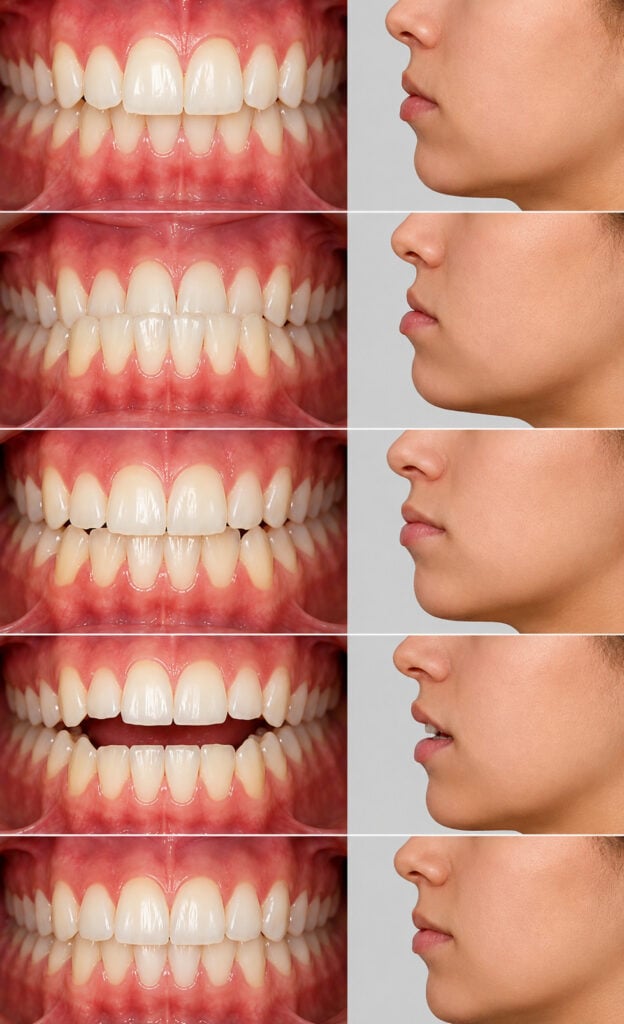
| Deep bite | The upper front teeth cover too much of the lower front teeth | Tooth wear, gum contact or difficulty cleaning |
| Increased overjet | The upper front teeth sit too far ahead of the lower teeth | Greater risk of damage to prominent front teeth |
| Underbite | The lower front teeth sit in front of the upper front teeth | Difficulty biting, uneven wear or jaw imbalance |
| Crossbite | One or more upper teeth bite inside the lower teeth | Uneven wear, gum problems or a shift in the bite |
| Open bite | Some upper and lower teeth do not meet when the mouth closes | Difficulty biting, chewing or producing certain sounds |
| Crowding | There is not enough space for the teeth to align properly | Overlapping teeth and more difficult oral hygiene |
| Spacing | There are larger spaces between teeth | Food trapping or an unstable tooth position |
Deep Bite And Overjet Are Not The Same
Deep bite and overjet are often confused. They describe different directions of overlap.
A deep bite refers to the vertical overlap of the upper front teeth over the lower front teeth. A small amount of vertical overlap is normal, but excessive coverage may allow the teeth to contact the gums or other soft tissues.
Overjet describes the horizontal distance between the upper and lower front teeth. When the upper teeth project too far forward, they may be more exposed to accidental damage.
Braces can move the teeth vertically and horizontally. The orthodontist designs the movement according to the exact relationship that needs correction.
How Do Braces Correct A Bite?
Braces apply controlled pressure to move teeth gradually. They do not force the teeth into place during one appointment.
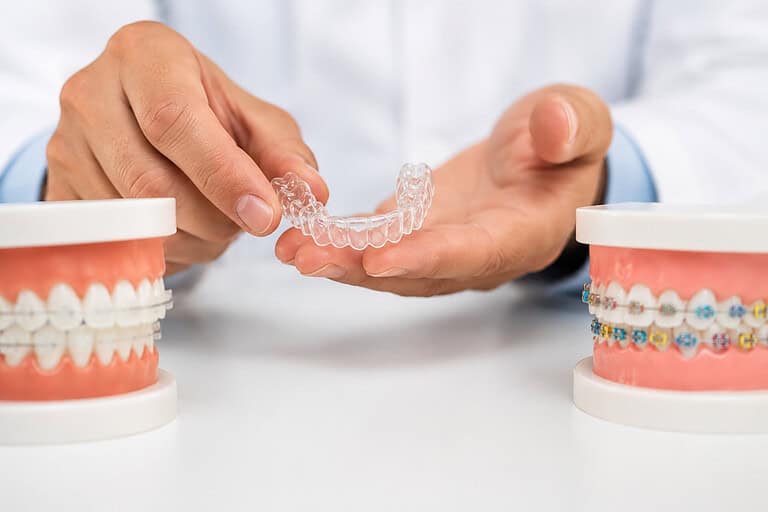
Fixed braces use attachments connected by an orthodontic wire. The wire guides the teeth toward planned positions, while regular adjustments maintain the necessary movement.
For bite correction, the orthodontist may also use:
- Elastic bands
- Coil springs
- Bite blocks
- Expanders
- Functional appliances
- Temporary anchorage devices in selected cases
- Retainers after active treatment
Each component has a specific role. Not every patient needs all of them.
The treatment plan may change as the teeth move. Regular appointments allow the orthodontist to monitor progress and make careful adjustments.
Why Are Elastic Bands Important?
Orthodontic elastic bands can apply force between the upper and lower teeth. This helps improve their relationship in ways that a wire alone may not achieve.
The position of the elastics depends on the bite problem. They may be used differently for an overbite, underbite, crossbite or open bite.
Patients must follow the orthodontist’s instructions carefully. Wearing elastics for fewer hours than recommended can slow progress, while using extra elastics does not make treatment safer or faster.
Le American Association of Orthodontists explains that elastic configurations are selected specifically for each patient’s bite. They should not be changed without professional instructions.
Braces Can Improve How Teeth Share Pressure
Chewing creates force. In a balanced bite, this pressure is distributed across several teeth.
When only a few teeth make heavy contact, they may experience greater wear. Other teeth may not contribute correctly to biting and chewing.
Orthodontic treatment aims to guide the teeth into positions where they can work together more effectively. This may reduce excessive contact on specific areas, although the result depends on the original condition and treatment response.
The final bite should be checked from the front, sides and back. Straight front teeth alone do not confirm that treatment is complete.
How Is A Bite Problem Diagnosed?
A complete orthodontic examination involves more than looking at the front teeth. The orthodontist studies tooth position, jaw relationship, facial growth and oral function.
The assessment may include:
- Examination of the teeth and gums
- Evaluation of how the jaws close
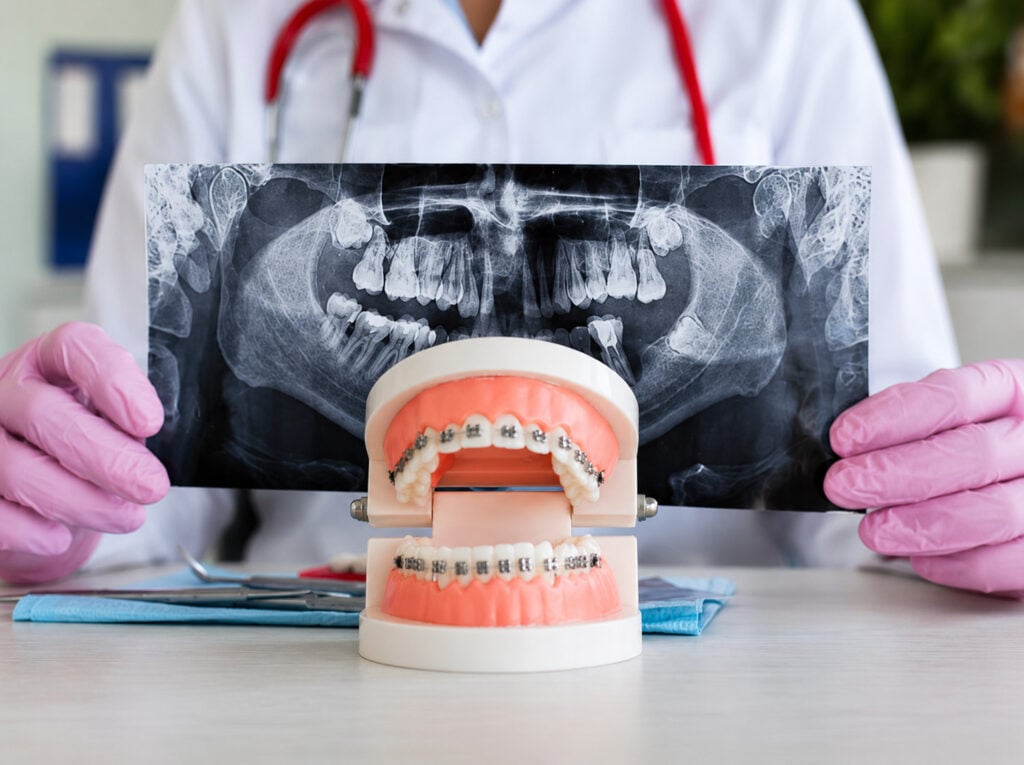
- Panoramic dental X-rays
- Additional orthodontic X-rays when needed
- Digital scans or impressions
- Clinical photographs
- Measurement of crowding or spacing
- Review of tooth wear
- Assessment of jaw growth
- Discussion of oral habits
At Endeta Dental Clinic, orthodontic treatment in Albania is planned according to these findings. The same type of visible bite problem may require a different approach in two patients.
Metal Braces For Bite Correction
Metal braces are commonly used to treat simple and complex orthodontic problems. They allow the orthodontist to control tooth movement in several directions.
The wire can be adjusted throughout treatment, while elastics and other components can be added when required. Metal braces remain fixed in place, so treatment continues throughout the day.
They may be suitable for:
- Significant crowding
- Deep bites
- Increased overjet
- Crossbites
- Open bites
- Teeth that need rotation
- More complex tooth movements
The exact suitability depends on the clinical assessment rather than age or appearance preference alone.
Appareils dentaires en céramique
Ceramic braces work through a similar fixed system. Their attachments are made to blend more closely with the natural tooth color.
They may be preferred by patients who want a less noticeable fixed appliance. The orthodontist must still determine whether they can provide the control required for the bite problem.
Ceramic braces require careful cleaning because plaque and staining around the appliance can become more visible. Patients should also follow instructions about foods that could damage the system.
Can Invisalign Correct Bite Problems?
Invisalign treatment uses a series of removable transparent aligners. Each aligner is designed to guide the teeth through a planned stage of movement.
Clear aligners may correct certain cases of:
- Crowding
- Spacing
- Deep bite
- Increased overjet
- Underbite
- Crossbite
- Open bite
Suitability depends on the severity and cause of the malocclusion. More complex cases may be better managed with fixed braces or a combination of orthodontic methods.
Aligners must be worn for the prescribed number of hours each day. Removing them too frequently can affect the planned movement and extend treatment.
Are Braces Enough For Every Bite Problem?
Braces can correct many malocclusions, but they cannot solve every jaw difference by moving teeth alone. This is especially relevant when the problem is caused mainly by the size or position of the jawbones.
Growing patients may sometimes benefit from functional appliances or other methods that guide development. Timing is important because some corrections are easier while growth is still active.
In adults with a severe skeletal difference, the treatment plan may involve braces combined with jaw surgery. This is only considered after a detailed assessment by an orthodontist and surgical team.
The patient should understand whether the plan is correcting the cause of the bite problem or only compensating through tooth movement.
How Long Does Bite Correction Take?
The treatment duration depends on the type of malocclusion, the amount of movement required and the patient’s response. Simple alignment may take less time than correcting a complex relationship between both dental arches.
Progress may also be affected by:
- Missed appointments
- Broken braces
- Poor elastic use
- Insufficient aligner wear
- Oral hygiene problems
- Tooth eruption
- Individual biological response
- Additional dental treatment
The orthodontist can provide an estimated timeline after completing the diagnostic assessment. It should be treated as an estimate rather than a guaranteed completion date.
Why Are Retainers Necessary?
Removing the braces does not mean that orthodontic care is finished. Teeth naturally tend to move after active treatment.
An orthodontic retainer holds the teeth while the surrounding tissues adapt. Retainers may be removable, fixed behind the teeth or used as a combination.
The orthodontist determines how often and how long they should be worn. Failing to use the retainer can allow the teeth and bite to shift.
Retainers must also be cleaned and checked. A broken or poorly fitting retainer should be assessed before noticeable movement occurs.
Why Choose Endeta Dental Clinic For Orthodontic Care?
Endeta Dental Clinic provides metal braces, ceramic braces, Invisalign and other orthodontic appliances. Treatment is planned by examining both tooth alignment and the relationship between the upper and lower jaws.
The clinic uses diagnostic imaging, digital records and regular monitoring to guide each stage. Patients receive instructions about hygiene, appliance care, elastic use and retention.
Endeta also provides general dentistry, periodontics and restorative treatments. This allows other oral health concerns to be addressed before or during orthodontic care when necessary.
Contacter la clinique dentaire Endeta
Do your upper and lower teeth feel as if they do not meet correctly? 🦷
Book an orthodontic evaluation at Endeta Dental Clinic. The team will examine your teeth, jaws and bite before explaining whether metal braces, ceramic braces, Invisalign or another orthodontic solution may be appropriate.
📩 Request your consultation today and take the first step toward better alignment, balanced function and long-term dental health.

 French
  English
  Italian
  Albanian